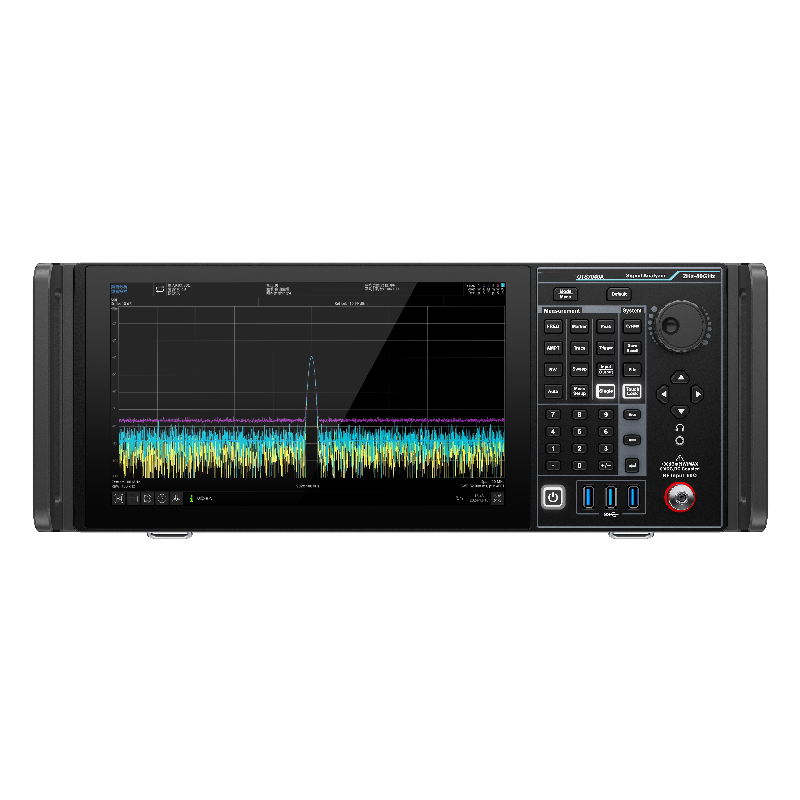
The communication industry (5G/4G and satellite communication) relies on precise signal analysis to ensure network performance and compliance, and the Signal analyzer 2Hz~40GHz delivers this critical capability. It covers ultra-wide frequency ranges, solving challenges like complex signal demodulation and interference detection in modern communication systems.
5G NR FR1/FR2 Development: Validating Millimeter-Wave Performance
まず最初に, 5G NR (especially FR2 millimeter-wave bands) demands ultra-wide bandwidth and low-phase-noise analysis. The Signal analyzer 2Hz~40GHz supports up to 160MHz real-time bandwidth, capturing 5G ultra-wide carrier signals without distortion.
さらに, its phase noise as low as -113 dBc/Hz @ 1GHz offset ensures accurate measurement of 5G beamforming signals, a key requirement for 3GPP Rel. 16/17 compliance. This solution helped a telecom equipment maker reduce EVM (Error Vector Magnitude) testing errors by 0.2 dB, accelerating their 5G base station commercialization.
4G LTE Network Optimization: Enhancing Coverage & Quality
4G LTE networks still serve massive users, requiring ongoing interference monitoring and signal quality optimization. The Signal analyzer 2Hz~40GHz quickly detects out-of-band emissions and co-channel interference with its >110 dB dynamic range.
さらに, it integrates LTE protocol analysis tools, enabling technicians to decode signaling messages and locate network bottlenecks. This solved a major operator’s rural coverage issue by identifying hidden interference from nearby industrial equipment, boosting 4G throughput by 35%.
Satellite Communication Link Testing: Ensuring Stable Transmissions
第二に, satellite communication (including low-orbit satellites) operates across diverse frequency bands (L, s, C, Ku) that demand full-band analysis. The Signal analyzer 2Hz~40GHz covers these bands seamlessly, supporting both uplink and downlink signal testing.
さらに, its high-sensitivity display average noise level (DANL) captures weak satellite signals, while the built-in noise coefficient option simplifies LNA (Low-Noise Amplifier) testing for satellite terminals. A satellite operator used this tool to reduce link drop rates by 42% by optimizing signal-to-noise ratio (SNR) parameters.
5G/4G Co-Existence Testing: Mitigating Interference Risks
5G and 4G networks often share adjacent frequency bands, creating potential interference risks. The Signal analyzer 2Hz~40GHz uses real-time spectrum analysis (RTSA) with >300,000 spectra/second refresh rate to capture transient interference between 5G and 4G signals.
例えば, it identified spurious emissions from a 5G base station that disrupted nearby 4G services, allowing engineers to adjust transmission parameters and eliminate conflicts. This solution ensures smooth coexistence of multi-generation cellular networks during the 5G rollout.
Satellite Terminal Production: Ensuring Mass-Production Consistency
Finally, satellite terminal manufacturers need fast, accurate testing for mass production. The Signal analyzer 2Hz~40GHz offers a 41 ms/scan speed (10 MHz RBW), enabling automated testing of satellite modems and transceivers on production lines.
Its compatibility with SCPI commands and remote control software allows integration into ATE (Automatic Test Equipment) systems, reducing testing time per unit by 50% compared to manual setups. This helps manufacturers meet tight delivery schedules while maintaining strict quality standards.
Core Value: Versatility & Precision for Communication Innovation
The Signal analyzer 2Hz~40GHz combines ultra-wide frequency coverage, high dynamic range, and multi-protocol analysis capabilities. It supports not only 5G/4G and satellite communication but also future-proofs testing for emerging communication technologies.
In the communication industry, it’s not just a testing tool—it’s a solution that accelerates technology development, ensures network reliability, and supports the seamless evolution of global communication systems.
Jetronl Instruments Co., Ltd. has specialized in the electronic measurement field for 35 years, covering various measurement needs across the entire electronic industry chain and providing precise measurement support.